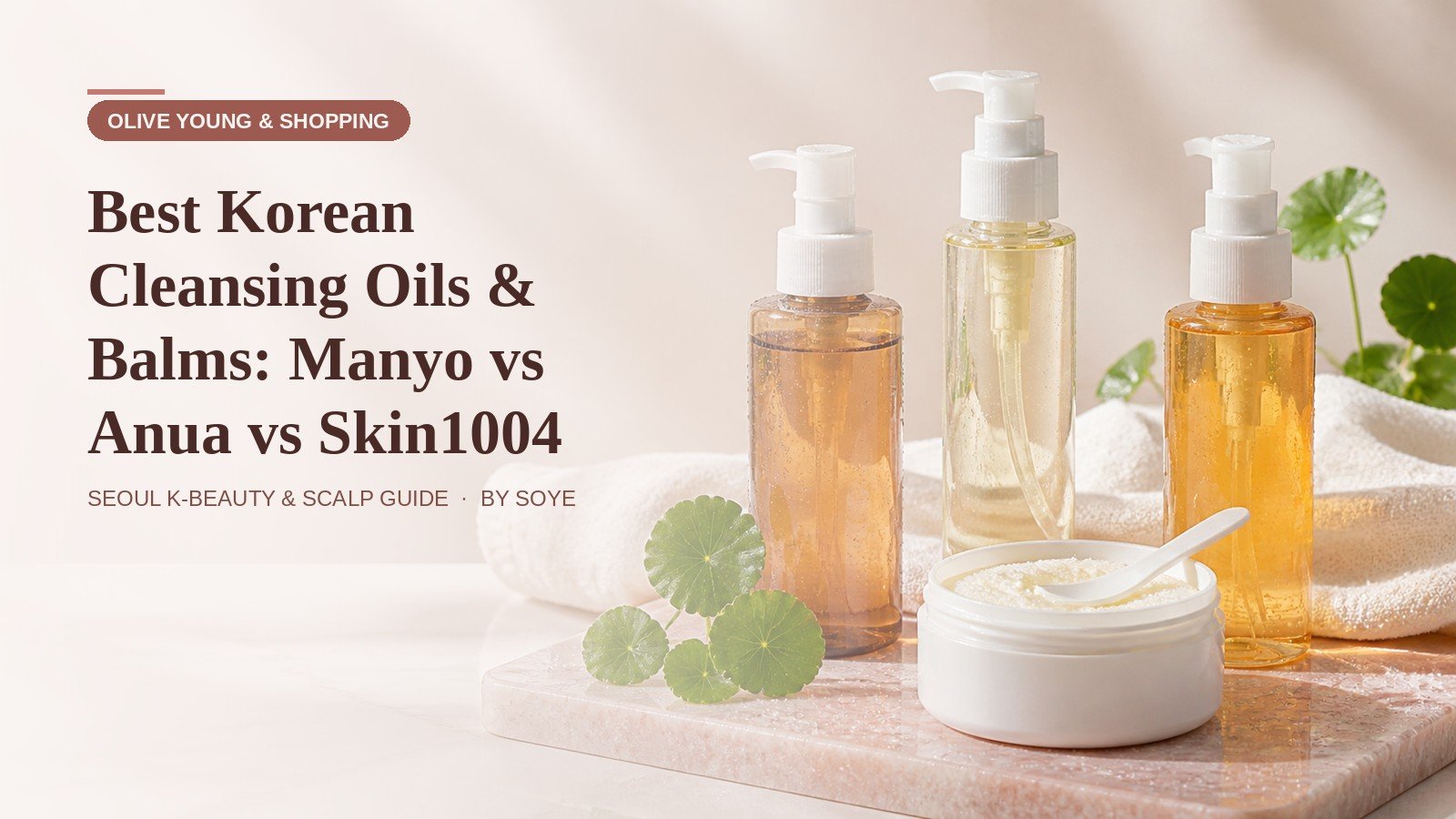
Every Olive Young in Seoul has the same shelf: four cleansing oils and balms Koreans rebuy without reading the label, and tourists buying whichever box shouts loudest. The bottles cost ₩11,700–25,900. What separates glowing skin from a week of closed comedones is not the pick — it is the 90 seconds after you pump it.
Quick Verdict
Oily or blackhead-prone: Anua Heartleaf (₩25,900 for 2×200ml). Dry or first-timer: Manyo Pure Soybean (₩23,900 for 2×200ml, five-time Olive Young winner). Reactive skin: treat Skin1004 with care — it is not fragrance-free. Carry-on only: Banila Co balm, ₩15,600.
Why cleansing oil breaks people out
Ask a Seoul dermatology clinic what brings in visitors with a sudden crop of small bumps on the cheeks and jaw, and the answer is rarely the product. It is the rinse. Three things go wrong:
- The oil never emulsified. Cleansing oil is oil plus an emulsifier — Sorbeth-30 Tetraoleate, PEG-20 Glyceryl Triisostearate, Sorbitan Sesquioleate — and that emulsifier only works when water is added while you are still massaging. Rinse straight under the tap and a film of oil and surfactant stays in the pore openings.
- No second cleanse. An oil cleanser is step one of two in Korea, not a standalone wash. Skip step two and that film is what you sleep in.
- Fragrance. Three of the four products below carry fragrance or essential oils high in the list. If your skin reacts to limonene or linalool, the oil is not the problem — the perfume is.
Note what is not on that list: the oil itself clogging pores. A rinse-off product sits on your face for about a minute before a surfactant takes it away — which matters when you read comedogenic ratings.
The 30-second emulsification rule
Manyo prints the timing on its own box: massage over a dry face, then wet your hands and massage about 30 seconds until the oil turns milky, then rinse lukewarm. Anua’s instructions say the same in fewer words — “emulsify with water until the makeup and dirt melt away”.
The chemistry is simple. Oil dissolves sebum, sunscreen and pigment; the emulsifier has one end that loves oil and one that loves water. Add water and those molecules form micelles that lift the oil off your skin so water can carry it away.
What success looks like: the oil goes from clear to opaque milk within five to ten seconds of wetting your hands, the slip disappears and it rinses without a film. If your oil stays clear and slippery, you added too little water — splash, massage, splash again. Cap the whole thing at 60–90 seconds: longer does not extract more, it just irritates.
Reading the Korean ingredient label
Korean law requires every ingredient in descending order above 1%, which is where the information gap opens. Marketing says “rice bran”; the label says what the bottle is made of.
Base oil is the first line. Manyo’s disclosure lists soybean oil at 670,000ppm — 67% of the bottle; the fermented rice bran its marketing leans on is rice bran oil at position 21, with rice ferment filtrate at 32. Anua starts with ethylhexyl palmitate, a synthetic ester, and puts its five “non-comedogenic plant oils” at positions 7 to 11. Skin1004 opens with two synthetic esters and caprylic/capric triglyceride fourth. Banila Co’s balm is a PEG-ester and synthetic-wax matrix with olive oil sixth.
Then check the comedogenic rating — with the caveat. The 0–5 scale everyone quotes comes from James Fulton’s 1989 rabbit-ear study, where each ingredient was applied at 10% in propylene glycol for two weeks. It graded a raw material, not a finished cleanser: Fulton called 0–1 “not significant”, 2–3 “borderline”, and only 4–5 reliably reproducible, and Kligman later argued vegetable oils are usually non-comedogenic.
| Oil in these bottles | Fulton rating | What it means in a rinse-off cleanser |
|---|---|---|
| Coconut oil | 4 | Avoid leave-on; still common in balms |
| Soybean oil (Manyo’s base) | 3 — borderline | Brief contact here, which is why 67% soybean suits dry skin |
| Olive oil | 2 crude, 1 refined | What cosmetics use is the refined grade |
| Jojoba / caprylic-capric triglyceride | 0–2 / 1 | Lightweight; the MCT in Anua and Skin1004 |
| Mineral oil | 0–2 | Not the villain it is sold as; none of these four uses it today |
Fulton, J. Soc. Cosmet. Chem. 40:321–333 (1989). “Results depend on source of raw material” applies to every oil listed.
So when Anua prints “non-comedogenic”, that is not the Fulton scale talking — it is a human-use test on the finished product, which is better evidence. Anua’s published four-week results: sebum −22.81%, blackheads −18.88%, whiteheads −20.09%. Manyo and Banila Co claim low-irritation testing rather than comedogenicity numbers, and Skin1004’s Korean listing carries no non-comedogenic claim at all.
The four bottles, compared
| Product (2026 name) | Base & key actives | Best for | Blackhead power | Emulsifies | Nov 2026 price |
|---|---|---|---|---|---|
| Manyo Pure Soybean Cleansing Oil 200ml formerly Pure Cleansing Oil |
67% soybean oil, hazelnut, grape seed, olive, jojoba, rice bran; orange, lavender and tea tree oils | Dry, normal, first-timers | Medium — softens sebum over weeks | Fast, thick milk | ₩19,900 list, ₩15,500 usual; 2×200ml ₩23,900 |
| Anua Heartleaf Pore Control 200ml | Ethylhexyl palmitate, butyl avocadate for sebum, heartleaf 10,000ppm; fragrance at position 6 | Oily, combination, blackhead-prone | Highest of the four | Fast, thin milk | ₩22,000 list; 2×200ml ₩25,900 |
| Skin1004 Centella Light 200ml | Ethylhexyl stearate, cetyl ethylhexanoate, MCT, bergamot oil at position 5, centella 10,000ppm, geranium and rose oils | Normal, dry, combination — brand does not list sensitive | Medium-low | Very fast, thinnest | ₩25,000 list, ₩21,250 sale |
| Banila Co Clean It Zero Original Balm 100ml | Cetyl ethylhexanoate, PEG-20 glyceryl triisostearate, synthetic wax, olive, jojoba; no mineral oil on the current label | All skin; travel; waterproof makeup | High on makeup, low on grit | Fast once melted | ₩20,000 list, ₩15,600 usual; 2×100ml ₩28,000 |
Olive Young Korea list and selling prices, 17 November 2026; per-100ml maths below. Discounts rotate weekly.
Which one belongs in your bag
Manyo Pure Soybean — the default, and the one that was renamed. The bottle that won Olive Young’s cleansing category five years running (2021–2025) now says “Pure Soybean” on the front, which is why tourists who searched “Manyo Pure Cleansing Oil” walk past it. It is genuinely oil-heavy, so it suits dry and normal skin and can feel like too much on an oily T-zone in July. There is also a Deep Clean version at the same ₩19,900 in a near-identical bottle — a different formula, not the award winner.
Anua Heartleaf — the acne-prone pick, with one asterisk. Its four-week human test numbers are the best documented here, and the texture is thin enough to use twice a day without dragging. The asterisk is fragrance at position six: if your skin stings from perfumed products, this is not the gentle option it looks like on TikTok.
Skin1004 Centella Light — read the label before believing the “sensitive skin” reviews. It is the lightest of the four and the centella is real at 10,000ppm, but the Korean label puts bergamot fruit oil fifth, then geranium and rose oils, and limonene and linalool at the end. The brand itself lists normal, dry and combination — not sensitive. With rosacea or a fragrance allergy, patch test on the jaw for three nights.
Banila Co Clean It Zero Original — the travel answer. A sherbet balm that melts on contact and lifts waterproof mascara better than any oil here; 22,901 Korean reviews average 4.9. The current label lists no mineral oil, so English posts calling it mineral-oil-based are out of date. Highest cost per millilitre of the four.
The four-step blackhead melt
- Dry hands, dry face, two pumps. Water first and the oil emulsifies on your palms instead of your pores. Work the nose, chin and between the brows for the first 30 seconds, where sebaceous filaments live. Roll, do not scrub.
- Sixty to ninety seconds, no longer. The grit on TikTok comes from softened sebum after several days of consistent use, not from a longer massage.
- Wet, massage 30 seconds, watch it turn milky. This is the step almost everyone skips. Splash twice if the milk looks thin, keep massaging until the slip disappears, then rinse lukewarm.
- Second cleanse, 30 seconds, then pat. A low-pH foam on damp skin, rinse, pat rather than rub, and moisturise within three minutes — the double cleanse removes barrier lipids with the makeup.
Your second cleanser, by skin type
| Skin type | Second cleanser | 2026 price | Why this pairing |
|---|---|---|---|
| Oily / acne-prone | Round Lab 1025 Dokdo Cleanser 150ml | ₩13,000 list, ₩11,700 usual | Low-foam, low-pH; clears Anua’s residue without stripping |
| Combination | Torriden Dive-In Cleansing Foam 150ml | ₩15,000 list, ₩10,500 sale | Hyaluronic base, lighter finish |
| Dry / tight after washing | Dokdo, or water only on non-makeup mornings | ₩11,700 | Stacking surfactants is what makes dry skin drier |
| Reactive / rosacea | Fragrance-free, and skip the oil on flare days | ₩11,700 | Two short contacts beat one long one |
Both foams are sold as weakly acidic; Korean retailer spec sheets list pH 4.5–5.5. Olive Young Korea, 17 November 2026.
Set maths and 2026 sale timing
Olive Young’s shelf price is not the price Koreans pay. The sets are where the value is:
- Manyo 2×200ml ₩23,900 — ₩5,975 per 100ml, cheapest in the store.
- Anua 2×200ml ₩25,900 — ₩6,475 per 100ml, about 8% more for a sebum-focused formula.
- Skin1004 200ml ₩21,250 — ₩10,625 per 100ml; you are paying for the texture.
- Banila Co 2×100ml ₩28,000 — ₩14,000 per 100ml, the balm premium at 2.3× Manyo.
Timing matters more than the label. Olive Young runs four seasonal sales a year plus one Black Friday event, which in 2026 ran 1–7 November and has closed. What is left this month is the Olive Day on 25–27 November — for Olive Members, a tier that needs a Korean mobile number — and the winter Olive Young Sale expected 3–9 December, when cleansing sets historically drop hardest. If your trip ends before December, buy the 2-pack; it is already 35% off list.
Buying from home is the expensive option: Olive Young Global lists the Manyo 400ml at US$30.10, Anua 400ml at US$25.90, Skin1004 200ml at US$25.00 and Banila Co 2×100ml at US$32.90 — at ₩1,338 to the dollar, 34% to 71% more than the Korean shelf before shipping.
Carry-on, duty-free and leaks
This is the part that ruins purchases at Incheon. The rule has not changed in 2026 despite the new CT scanners: from Korea, every liquid or gel in carry-on must be in a container of 100ml or less — judged by the container, not what is left in it, inside one 1L clear ziplock bag per person. A 200ml oil, even one third full, is confiscated.
- 200ml oil: check it. Wrap the pump in a zip bag and tape it shut; pumps leak with pressure changes even in the hold.
- Duty-free is the loophole. Liquids bought after security in a sealed duty-free bag are allowed regardless of volume, as long as the bag stays sealed until your final destination — but only if you are not transferring through a country that re-screens.
- The balm is the carry-on winner. A 100ml jar is inside the limit anyway, pressure changes do nothing to it, and it will not leak into your clothes.
Five checks before you pay
- Is it the award bottle or the lookalike? Manyo sells Pure Soybean and Deep Clean at the same price in near-identical packaging. Read the Korean name: 퓨어 소이빈 vs 딥 클린.
- Does the label say 논코메도제닉, or only “non-comedogenic” in English? Only some carry a Korean human-use result. Anua does; the others lean on irritation tests.
- Check positions 5 to 10 for fragrance. Limonene and linalool must be declared; if both appear and your skin is reactive, change bottle rather than routine.
- Pick the set, not the single. The 2×200ml sets are 35% off list and cheaper per millilitre than any single bottle.
- Price-check before you fly. Olive Young Global is 34–71% more for the same product.
FAQ
Can I use cleansing oil every day?
Yes, if you emulsify properly and follow with a water-based cleanser. Dry skin often does best with oil only in the evening; oily skin can use it twice a day. Small closed bumps in week two usually mean a short rinse, not a bad bottle.
Will it sting my eyes?
Oil does not sting, but a film over the eye blurs vision for a few minutes. Keep eyes closed, work the lash line with eyes shut, tilt your head back to rinse. Waterproof mascara is better handled with a lip-and-eye remover.
Does it really remove waterproof mascara and sunscreen?
Sunscreen yes — oil is the only thing that reliably lifts water-resistant filters and the sebum they sit in. Waterproof mascara: the balm does, the oils mostly do, with 20–30 seconds of gentle rolling and a follow-up foam.
How many pumps, and how long does a bottle last?
Two pumps for a full face, three for heavy makeup. At two pumps a day a 200ml bottle lasts roughly two months, so the ₩23,900 Manyo 2-pack is about four months of cleansing.
Is mineral oil bad for acne?
Not according to the data. Fulton graded it 0–2 and Kligman later argued the older positive results were false positives of the rabbit assay. None of the four uses it, but “mineral oil free” is marketing, not a safety upgrade.
Can I skip the second cleanser if my skin is sensitive?
You can, if you rinse longer and accept a small residue risk. The usual Korean compromise: oil plus a low-foam weakly acidic cleanser for 30 seconds.
Final Summary
- Technique beats the bottle: dry hands, 60–90 seconds of rolling, 30 seconds of emulsifying until milky, then a 30-second low-pH second cleanse.
- Oily and blackhead-prone: Anua Heartleaf, ₩25,900 for 2×200ml — the only one here with published four-week sebum (−22.8%) and blackhead (−18.9%) results.
- Dry and first-timers: Manyo Pure Soybean, ₩23,900 for 2×200ml, 67% soybean oil, five consecutive Olive Young awards — not Deep Clean.
- Reactive skin: Skin1004 is light and centella-rich but carries bergamot, geranium and rose oils. It is not the fragrance-free pick.
- Carry-on: 200ml oils must be checked or bought duty-free after security; the 100ml Banila Co balm is the only one that flies without drama.
Buying for the rest of the trip? The Olive Young shopping and tax refund guide covers the ten holy-grail products and the refund desks, and the sheet mask guide sorts the same shelf by skin type. If you are exfoliating after all this cleansing, start with the PDRN, exosome and centella ingredient guide so you do not stack two actives on a fresh barrier. For the arrival-day version, see the Seoul Olive Young shopping guide.

Skincare Disclaimer: This guide is informational only and not medical advice or a diagnosis. Patch test new cleansers on the jaw for three nights and see a dermatologist for persistent cysts, rashes or irritation. Comedogenic ratings describe raw ingredients in a 1989 animal study, not the finished product or your own skin. Prices, sets and sale dates were checked in Seoul on 17 November 2026 and change without notice.
Last checked: 17 November 2026. Ingredients from each brand’s Korean disclosure and Olive Young Korea; comedogenicity from Fulton 1989; carry-on rules from Incheon International Airport and MOLIT standard 2021-864; exchange rate ₩1,338.2 per dollar, Seoul close 17 November 2026.